Sizing Guide
Quilt Sizes: Choosing the Perfect Size
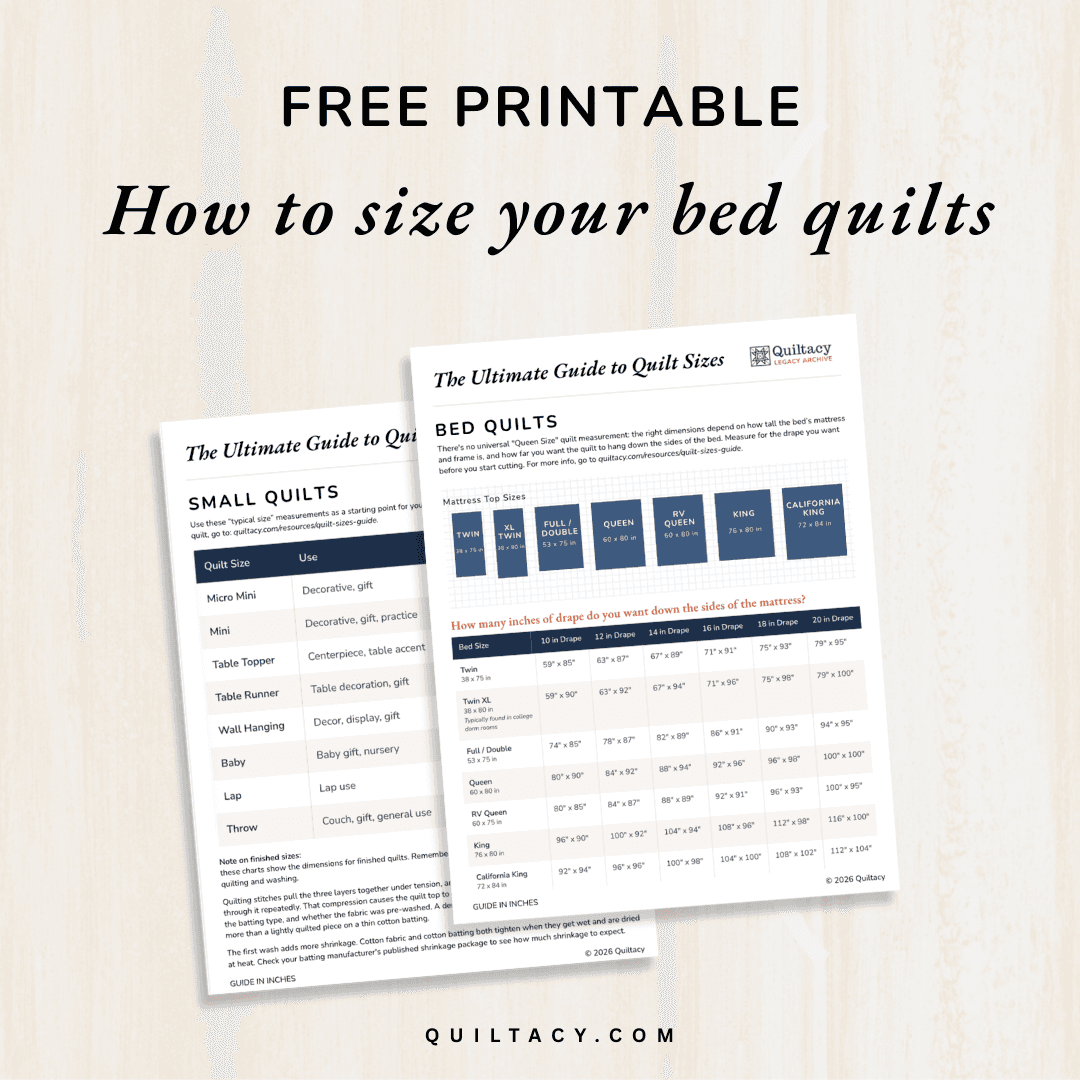
Picking a quilt size sounds simple until you're standing at the cutting table, rotary cutter in hand, trying to decide. How far should it hang off the bed? Is a throw really big enough for the couch? What even counts as a baby quilt? This guide answers all of it. You'll find every standard quilt size in both inches and centimeters, a drape chart so your bed quilt hangs exactly the way you picture it, and a plain-English rundown of what each size is actually good for, so you can choose with confidence before you cut a single piece. We've also put together a free 2-page printable version of this guide (available in both inches and cm) that you can grab below.
Get the free 2-page printable
Pop in your email and we'll unlock the printable right away. It comes in both inches and cm. You'll also join our list for the occasional quilting tip. Unsubscribe anytime.
We'll only email you quilting tips and Quiltacy updates. See our Privacy Policy.
Quilt Sizes Chart for Bed Quilts
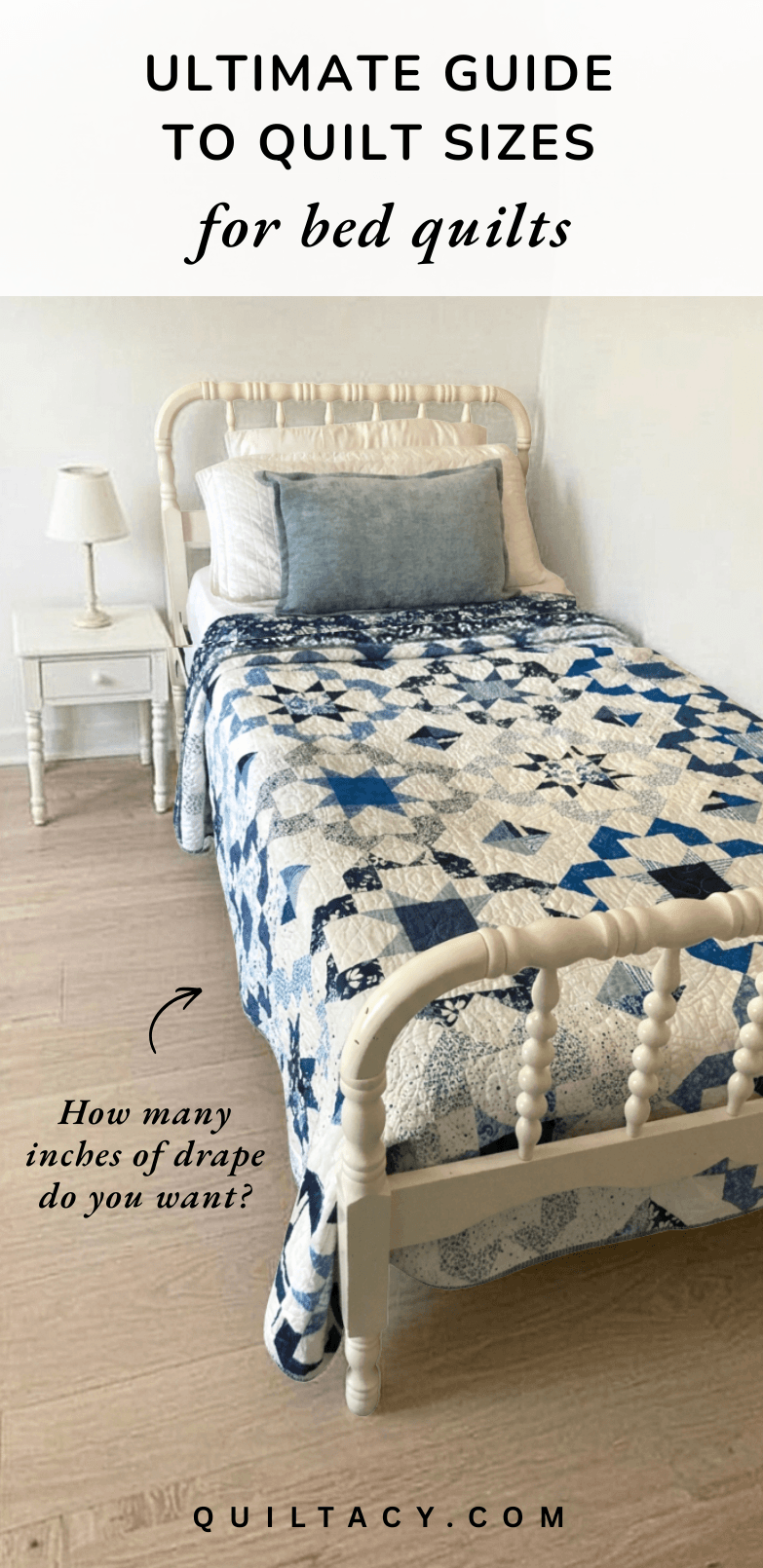
If you've ever looked up quilt sizes, you've probably seen the typical charts: two numbers listed next to "Queen Size," just one length and one width. The trouble is that a quilt's finished size isn't really about the mattress at all; it's about how far you want the quilt to hang down the sides of the bed. After all the cutting, piecing, and quilting, few things sting quite like spreading your finished quilt across the bed and seeing it hang just an inch or two down the sides. So before you commit to a size, it's worth measuring for the drape you actually want.
How many inches of drape do you want down the sides of the mattress?
| Bed Size | 10 in Drape | 12 in Drape | 14 in Drape | 16 in Drape | 18 in Drape | 20 in Drape |
|---|---|---|---|---|---|---|
| Twin38 x 75 in | 59" x 85" | 63" x 87" | 67" x 89" | 71" x 91" | 75" x 93" | 79" x 95" |
| Twin XL38 x 80 inTypically found in college dorm rooms | 59" x 90" | 63" x 92" | 67" x 94" | 71" x 96" | 75" x 98" | 79" x 100" |
| Full / Double53 x 75 in | 74" x 85" | 78" x 87" | 82" x 89" | 86" x 91" | 90" x 93" | 94" x 95" |
| Queen60 x 80 in | 80" x 90" | 84" x 92" | 88" x 94" | 92" x 96" | 96" x 98" | 100" x 100" |
| RV Queen60 x 75 in | 80" x 85" | 84" x 87" | 88" x 89" | 92" x 91" | 96" x 93" | 100" x 95" |
| King76 x 80 in | 96" x 90" | 100" x 92" | 104" x 94" | 108" x 96" | 112" x 98" | 116" x 100" |
| California King72 x 84 in | 92" x 94" | 96" x 96" | 100" x 98" | 104" x 100" | 108" x 102" | 112" x 104" |
How many centimeters of drape do you want down the sides of the mattress?
| Bed Size | 25 cm Drape | 30 cm Drape | 35 cm Drape | 40 cm Drape | 46 cm Drape | 50 cm Drape |
|---|---|---|---|---|---|---|
| Twin96.5 × 190.5 cm | 150 × 216 | 160 × 221 | 170 × 226 | 180 × 231 | 191 × 236 | 201 × 241 |
| Twin XL96.5 × 203.5 cmTypically found in college dorm rooms | 150 × 229 | 160 × 234 | 170 × 239 | 180 × 244 | 191 × 249 | 201 × 254 |
| Full / Double134.5 × 190.5 cm | 188 × 216 | 198 × 221 | 208 × 226 | 218 × 231 | 229 × 236 | 239 × 241 |
| Queen152.5 × 203.5 cm | 203 × 229 | 213 × 234 | 224 × 239 | 234 × 244 | 244 × 249 | 254 × 254 |
| RV Queen152.5 × 203.5 cm | 203 × 216 | 213 × 221 | 224 × 226 | 234 × 231 | 244 × 236 | 254 × 241 |
| King193 × 203.5 cm | 244 × 229 | 254 × 234 | 264 × 239 | 274 × 244 | 284 × 249 | 295 × 254 |
| California King183 × 213.5 cm | 234 × 239 | 244 × 244 | 254 × 249 | 264 × 254 | 274 × 259 | 284 × 264 |
Quilt Sizes Chart for Smaller Quilts
The numbers below are considered "typical" measurements for each quilt type. However, you can and should adjust your sizes to whatever you'd like! Use these measurements as just a starting point.
| Quilt Size | Use | Typical Finished Size (inches) | Typical Finished Size (cm) |
|---|---|---|---|
| Micro Mini | Decorative, gift | 6" x 6" or smaller | 15 x 15 cm or smaller |
| Mini | Decorative, gift, practice | 24" x 24" or smaller | 60 x 60 cm or smaller |
| Table Topper | Centerpiece, table accent | 24" x 24" | 60 x 60 cm |
| Table Runner | Table decoration, gift | 14" x 60" | 35 x 152 cm |
| Wall Hanging | Decor, display, gift | 30" x 42" | 76 x 106 cm |
| Baby | Baby gift, nursery | 30" x 40" | 76 x 100 cm |
| Lap | Lap use | 40" x 60" | 100 x 152 cm |
| Throw | Couch, gift, general use | 50" x 65" | 125 x 165 cm |
Note on finished sizes: the sizes above are the dimensions you're aiming for when the quilt is complete. For the larger sizes, remember to add about 3 inches to each dimension of your quilt top to account for shrinkage when quilting. Shrinkage varies by batting type and stitch density, and whether the quilt is longarmed or quilted on a domestic sewing machine.
What Each Quilt Size Is Actually For
Micro quilts
Tiny things are always adorable. Micro quilts can be made for tiny-piecing challenges, as entries in miniature quilt swaps, as ornaments or dollhouse bedding, or just for something fun to hang on a wall. Experienced quilters take them on for the precision puzzle: the pieces are small, the seam allowances are smaller, and every thread counts. A micro is the right choice if you love detailed handwork and want a real technical challenge.
Mini quilts
Mini quilts finish at roughly the size of one or two sheets of paper. They're made as ornaments, framed wall art, guild challenge pieces, or gifts that don't need much yardage. Quilters use them to test a block pattern before committing to a full project. A mini is the right starting point if you want to try a new technique without a major time investment.
Table toppers
A table topper sits at the center of a dining or side table as a decorative accent. They're not designed to hang over the table edges the way a tablecloth would. The point is to protect the surface and display the patchwork. Table toppers are popular gifts because they're a manageable size for the maker and useful for the recipient.
Table runners
Table runners are long and narrow to run down the center of a table. They're one of the most-gifted quilt projects because they're fast to make and look polished. The length varies by table size: a 48-inch runner works for a four-person table, while 60 to 72 inches suits a larger dining table. Table runners can be made to stay entirely on the tabletop, or made to drape over the two short ends of a rectangular table.
Wall hangings
Wall hangings are made specifically for display, not for use on a bed or couch. Most include a hanging sleeve on the back for a dowel rod, or loops for a quilt hanger. They're a natural choice when a design is too beautiful to fold away, or when you want to include elements that wouldn't stand up to regular use and washing (such as delicate applique, beads, or sequins).
Baby quilts
Baby quilts are sized to use as a play mat, to wrap around a baby while in a parent's arms, or as a keepsake. They're small enough to be easily washed and light enough that a parent can use them without worry. Most baby quilts are gifts. The finished size is also manageable for a quilter who wants to make something meaningful without a months-long commitment, or the budget needed for a king size quilt.
A note on safety: today's parents are instructed to keep blankets and quilts out of the crib entirely. Pediatric safe-sleep guidance (from groups like the American Academy of Pediatrics) calls for a bare sleep space, with no quilts, blankets, pillows, stuffed animals, or bumpers, for at least a baby's first year. Soft bedding in the crib raises the risk of SIDS (Sudden Infant Death Syndrome) and accidental suffocation, so the safest crib holds nothing but a firm mattress and a fitted sheet.
Lap quilts
A lap quilt is large enough to cover your legs and lap while you're sitting, but small enough that it won't pool on the floor or tangle around your feet. They're made for the couch, the reading chair, the recliner, or the porch, anywhere you want a little warmth without the bulk of a full bed quilt. Lap quilts are a favorite for charity and comfort giving, from nursing homes to chemo chairs, because they're cozy, easy to wash, and stay put on a lap. For a wheelchair user, a lap quilt measuring about 36" x 40" (or 92 x 102 cm) is better, to avoid the corners getting tangled into wheels.
Throw quilts
Throw quilts can finish from 50x65 to 60x80 inches, and can be square or rectangular shaped. They are wide enough to wrap around your shoulders, or long enough to cover you from collarbone to toes if you're average height. The smaller end of the range, around 50x65, reads as a decorative accent on a chair or the end of a bed more than a functional covering. If someone asks you for a "couch quilt," aim for 60x80 inches.
Twin quilts
Twin size quilts are the go-to for single-sleeper beds: kids' rooms and bunk beds, guest rooms and daybeds, and the bedrooms in an RV. Because a twin is the smallest of the standard bed sizes, it's often a quilter's first full bed quilt: less yardage, less time, and less of a commitment than a queen or king while still being a genuinely useful finished piece. Twin quilts also make popular gifts: for a child moving out of a crib, a high school graduate, or anyone setting up a guest room.
Twin XL quilts
A Twin XL quilt is made for a longer twin bed, the kind found in college dorm rooms and some adjustable beds. It suits a single sleeper who needs the extra length a standard twin doesn't give, so it's the natural pick for a tall teen, a student heading off to college, or a daybed that doubles as seating. They're a satisfying way to send a graduate off with a little handmade warmth from home.
Queen quilts
The queen is the most common bed size in homes today, which makes a queen quilt the one most quilters reach for when they're making something for their own bed or a couple's room. A queen quilt is a real project with plenty of piecing and quilting, so it's often the quilt people make when they want a true centerpiece for the bedroom, or a milestone gift like a wedding or anniversary quilt.
RV Queen quilts
An RV quilt is made for life on the road: the beds in campers, motorhomes, and travel trailers. These built-in beds are a bit shorter than standard queen mattresses, so an RV quilt is made to cover the bed neatly without extra fabric pooling on the floor. They're a favorite for travelers who want their home away from home to feel cozy and personal, and because they're easy to wash and pack away, they hold up to quick weekends and long trips alike.
King quilts
A king is a substantial quilting undertaking and is often a labor-of-love project. It is a statement piece for a primary bedroom or an heirloom meant to be handed down. Quilters usually take one on when they want their most impressive work on display in the room where they'll see it every day.
California King quilts
A California King runs longer and a little narrower than a standard king to suit taller sleepers. They're less common than the other sizes, which makes a well-fitted Cal King quilt especially appreciated by the people who own one.
Which size should a beginner start with?
If you're just starting out, a mini, table topper, or table runner is the right first project. All three are forgiving on fabric requirements, finish quickly, and teach you the full construction process. A throw at 60x80 is a natural step-up once you're comfortable with a longer project.
How Much Does a Quilt Shrink After Quilting and Washing?
Why quilt sizes shrink during quilting
Quilting stitches pull the three layers together under tension, and the batting compresses as the needle passes through it repeatedly. That compression causes the quilt top to draw in. The amount depends on the stitch density, the batting type, and whether the fabric was pre-washed. A densely quilted piece on a high-loft batting shrinks more than a lightly quilted piece on a thin cotton batting.
The first wash adds more shrinkage. Cotton fabric and cotton batting both tighten when they get wet and are dried at heat. Check your batting manufacturer's published shrinkage specs before you cut, since rates vary by fiber content and construction.
A simple rule of thumb for quilt shrinkage
Typically, expect total shrinkage of 3% to 7% from start to finished-and-washed quilt. On a 60x80 throw, that's roughly 2 to 4 inches per dimension, though this varies by batting type and stitch density. Build that into your plan for your quilt top, so that the finished quilt lands at the size you want.
Frequently Asked Questions About Quilt Sizes
What size quilt is 60x80?
A 60x80 quilt is generally considered a large throw quilt, but could also be used on a twin bed with minimal fabric draping down the sides. It works as a couch quilt for most adults.
What's the difference between a throw and a lap quilt?
Both are used for warmth on a couch or chair, but a lap quilt covers only the legs while seated, while a throw is long enough to cover from shoulder to foot when you're stretched out.
How much bigger should a quilt be than the mattress?
Plan for at least 10 inches of drop on each side and 10 to 15 inches at the foot, depending on how the bed is styled. For exact measurements, view the bed quilt chart above.
What size quilt do I need for a California King bed?
A California King mattress is 72x84 inches, which is narrower and longer than a standard King (76x80 inches). Your quilt should finish at 90x108 minimum for modest drop, or up to 104x108 for fuller coverage. Don't use a standard King pattern without adjusting the dimensions. The mattress proportions are different.
How much does a quilt shrink after quilting and washing?
Expect typically 3% to 7% total reduction after quilting and a first wash. Check your batting manufacturer's published specs for the precise figure, since rates vary by fiber content and construction. On a 60x80 quilt, that's roughly 2 to 4 inches per dimension, though this varies by batting type and stitch density. The dedicated shrinkage section above breaks down how much comes from quilting versus the first wash.
What size is a homemade quilt?
Homemade quilts don't follow a single standard because quilters size to the recipient, the use, and the pattern. The most common homemade sizes are throw (50x65 to 60x80 inches) for general gifting, baby (36x45 to 40x50 inches) for baby gifts, and twin or queen for bed quilts. The sizes in this chart reflect what many quilters make, but they're starting points, not rules.
Is 50x60 or 60x80 better for a couch quilt?
60x80 is more useful. A 50x60 quilt covers the legs of a seated adult but leaves your torso exposed when you lie down. At 60x80, you can pull it up to your chin and still have coverage to your feet if you're average height. If the goal is a couch quilt someone will actually reach for, make it 60x80.
Free Printable: Ultimate Guide to Quilt Sizes
Want a copy you can keep at your cutting table? Download the free 2-page printable version of this guide. It includes the bed quilt drape chart and the smaller quilt sizes chart, and it comes in both inches and centimeters.
Get the free 2-page printable
Pop in your email and we'll unlock the printable right away. It comes in both inches and cm. You'll also join our list for the occasional quilting tip. Unsubscribe anytime.
We'll only email you quilting tips and Quiltacy updates. See our Privacy Policy.