Printing Your Archive
How to Print Your Project Records
Digital records are convenient and searchable, but they depend on platforms, passwords, and devices. Sometimes, we just want to hold a physical object in our hands. That's why Quiltacy prioritizes making all of your project records easily printable. When you store your project records in both digital form and printed form, you keep your archive truly safe.
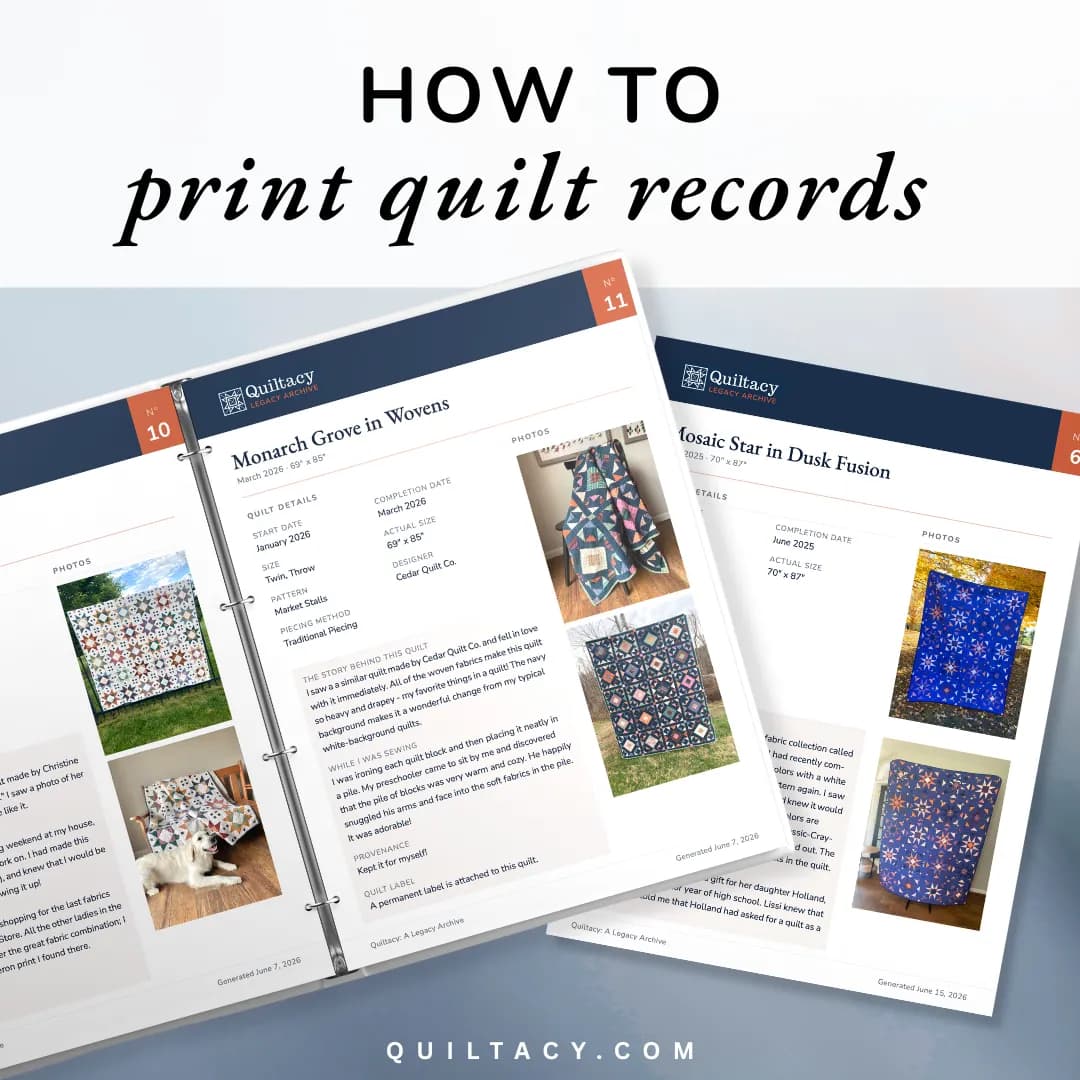
The single project record
A printed record of one quilt is useful in several ways. It can travel with the quilt as a gift, giving the recipient the full story of what they're receiving: who made it, when, from what fabrics, and why. It can assist as documentation for insurance or appraisal purposes. It also makes a meaningful addition to a memory box or binder.
A good single project record includes at least one clear photograph, the essential details about the project (its name, dates, size, pattern), and the story behind the piece. The story is the part most likely to be lost, yet it's the part future generations will most want to read!
The complete archive PDF
With Quiltacy, you can print your complete archive of quilts and sewing projects, creating a visual catalog of everything you've made. You get the best of both worlds: a digital record that's easy to update and search, and a tangible record you can hold in your hands.
A printed quilt archive makes a unique memento for children or grandchildren, especially after a quilter has passed away. Quilts can't exist in multiple places at once, but copies of a printed archive can be given to multiple loved ones. It serves as a lasting record of a lifetime's work.
Practical notes on printing
Print on heavier paper than typical copy paper, especially if you're printing double-sided. Archival or acid-free paper resists yellowing over decades. We recommend Hammermill Premium Color Copy in 28 lb. (or higher), in the color 100 Bright. If you have access to a printer that handles cardstock, printing the cover page on heavy card would be wise.
For a document you intend to keep for decades, avoid dye-based inks, which fade significantly over time. Pigment-based inks (used in most current photo printers) are substantially more archival. If you're printing at a print shop, ask about their archival paper and ink options.
Store printed records away from direct light and in a consistent environment. A simple archival binder kept in a drawer or cupboard is sufficient.
Once printed, put your full quilt archive into a binder, to easily add to in the future. Alternatively, bind your quilt archive into a spiral bound or hardcover book for posterity.